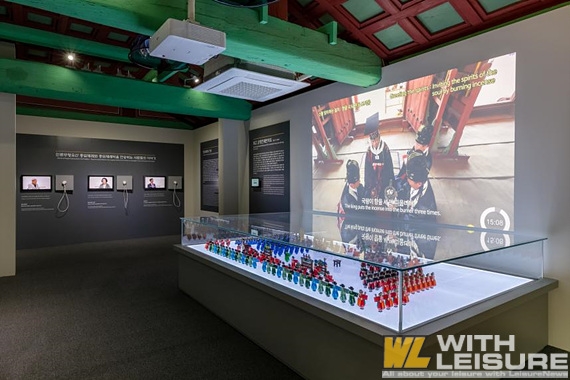
The Palaces and Tombs Center of the Cultural Heritage Administration announced that, to commemorate the launch of the Korea Heritage Service, it will reopen the Hyangdaecheong exhibition hall at Jongmyo after a renovation, together with the Korea Cultural Heritage Foundation (Chairman Choi Young-chang), and will also open the interior of Mangmyoru, next to Hyangdaecheong, on a special basis.
Jongmyo Hyangdaecheong was where the incense, prayer texts (chukmun) and silk offerings (pyebaek) used in the Jongmyo Jerye rites were received and stored, and where the officials conducting the rites waited. Mangmyoru was the building that housed the Jongmyoseo (宗廟署), the government office in charge of managing Jongmyo during the Joseon era. It was also a place where kings who came to perform the rites would commemorate their predecessors, and writings they left here were made into plaques and hung.
The Jongmyo Hyangdaecheong exhibition hall consists of two exhibition rooms, 'Deuo' and 'Jio', which explain the meaning and value of Jongmyo, the royal Confucian shrine, as well as Jongmyo Jerye and Jongmyo Jeryeak (the ritual music), in an accessible way.
In the 'Deuo' room, themed on Jongmyo as a World Heritage site, visitors can learn through a picture book how the sinju (spirit tablet), the master of Jongmyo, is made. The room examines the meaning of the sinju, the medium through which descendants meet their ancestors in rites, through the kings' tablets enshrined at Jongmyo, the tablets of ordinary sadaebu (scholar-officials), the tablets of meritorious subjects honored at Gongsindang, and the jibang (paper tablets) used in modern family ancestral rites. In addition, the changes to Jongmyo's Jeongjeon and Yeongnyeongjeon from 1395 to 1991 and the features of Jeongjeon's architecture seen through numbers can be viewed on a kiosk and in a video respectively, and a realistically recreated space of the Taejo shrine chamber is also provided.
In the 'Jio' room, themed on Jongmyo Jerye and Jongmyo Jeryeak, which are Intangible Cultural Heritage of Humanity, <LEGO Ohyang Chinje Banchado> by LEGO artist Colin Jinn is on display, depicting the banchado (班次, procession order) of the Jongmyo Jerye that Joseon kings performed in person. A total of 209 figures, including the king, the crown prince, ritual officials, the orchestra and dancers performing Jongmyo Jeryeak, and civil and military officials observing the rite, along with 26 types of instruments, are vividly rendered with more than 20,000 LEGO bricks. Visitors can also listen to the entire Jongmyo Jeryeak as performed in accordance with the Jongmyo Jerye procedure, and hear, through interview videos, the stories of the bearers of Jongmyo Jerye and Jongmyo Jeryeak, a living tradition that has continued from the founding of Joseon to the present day.
The Jongmyo Hyangdaecheong exhibition hall will operate permanently. During Jongmyo's timed-entry tour schedule (weekdays), visitors can view the exhibition after touring the Jongmyo grounds for one hour with a guide; during the general admission schedule (weekends, public holidays and Culture Day), visitors can tour freely without a guide. The hall is open from 9 a.m. until 30 minutes before Jongmyo closes (18:00 from February to May and September to October; 18:30 from June to August; 17:30 from November to January).
Mangmyoru, next to Hyangdaecheong, will be specially opened to visitors from May 17 to June 30 (daily, 10 a.m. to 4 p.m.) to mark the launch of the Korea Heritage Service. It sheds light on the stories of the heritage caretakers who have tended and managed Jongmyo, from the Joseon-era Jongmyoseo (宗廟署) to today's Jongmyo Management Office of the Palaces and Tombs Center. From the numaru (elevated wooden-floored pavilion), visitors can take commemorative photos while overlooking the lotus pond (蓮池) in fresh greenery and the panorama of Jongmyo, and a hands-on program in which participants assemble a model of Jongmyo's Jeongjeon will also be offered.
An official at the Palaces and Tombs Center of the Cultural Heritage Administration said, "We will continue to pursue proactive administration by steadily developing new exhibitions and content that make use of palace and royal tomb heritage, thereby spreading the value of national heritage."