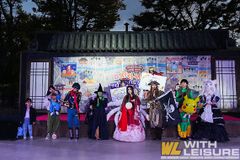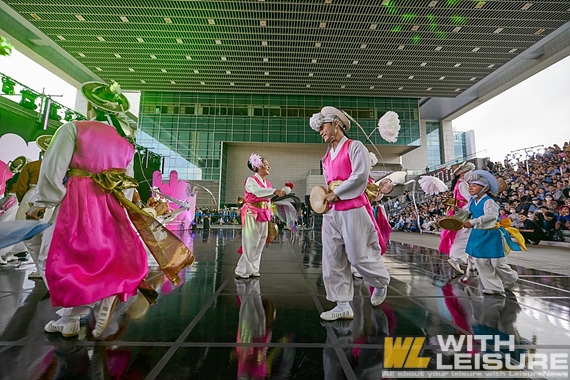
'2024 Great Heritage Meets Today,' hosted and organized by the Korea Traditional Performing Arts Promotion Foundation (Chairman Kim Sam-jin) and co-organized by the National Museum of Korea and the National Museum Foundation of Korea, will be held at the Open Plaza of the National Museum of Korea from September 14 to 18, during the Chuseok holiday.
From 2018 to 2023, 'Great Heritage Meets Today' was held at the National Museum of Korea, a treasure house of tangible heritage, centered on items inscribed on UNESCO's Representative List of the Intangible Cultural Heritage of Humanity. This year it has expanded to include performances of all traditional performing arts genres, including intangible cultural heritage of humanity. With newly created performances reinterpreted by artists in diverse fields, including instrumental music, vocal music and yeonhui (traditional folk performance), alongside intangible heritage of humanity all in one place, the event is expected to offer a good opportunity for families and relatives to enjoy traditional performances together over the holiday.
Opening the first day of the Chuseok holiday, the Bongsan Talchum Preservation Association presents 'Tal: Bakkum' (Mask: Transformation). It adds modern sound to various dances, including gilnori (procession), nojangchum (old monk dance) and sajachum (lion dance), heightening the dramatic focus and offering diverse enjoyment. The witty dialogue, which was mostly in archaic language and made it hard for audiences to relate, has been rewritten in modern Korean, creating a stage that even first-time viewers of Bongsan Talchum can easily understand.
'Haegeum Plus,' formed by haegeum player Kang Eun-il, who constantly attempts to blend various genres into traditional music, to present music in which Korean traditional instruments and Western instruments blend together, performs under the title 'Old Future.' The program includes a haegeum rhapsody in which European and Asian melodies blend exquisitely, as well as a passage from Sugungga that lets audiences feel the charm of funky jazz and samulnori.
On the second day, the 15th, 'Kim Ju-hong and Noreummachi,' who create a stage of exuberance and passion through an original idiom of Korean traditional music, meet the audience. Their performance 'Heotteunsori' does not carry the negative meaning of reckless chatter; instead, it captures the process of realizing on stage the flashes of inspiration that arise in artistic practice, offering a fresh taste of contemporary traditional music.
After the stage of seasoned, established artists, the folk ensemble 'Seo Ui-cheol Gadan,' representing the MZ generation, takes the stage. With 'Hangawi-maji Good Luck Gut,' covering Chungcheong-do, Seodo, Namdo, Gyeonggi and Seoul, the group meets the public so that audiences can see the many facets of 'gut,' one of Korea's traditional customs.
The first performance on the third day, the 16th, brings together 'Samulnori Hanmaek,' which is active in creating new works in traditional yeonhui, and the 'Choi Ju-yeon Dance Company,' which seeks to move audiences through uniquely Korean melodies and dance. They present 'Itda: Momjit-euro' (Connecting: Through Movement), which carries the meaning of reconnecting our traditional arts, which have now become heritage, with new sounds and gestures.
Next, the Korea National University of Arts alumni ensemble 'Gugak Ensemble Hyangnyu' performs 'A Tour of Autumn Fragrance,' playing various pansori, folk songs and concertos, including 'Beautiful Country,' which is frequently performed at national events and beloved by the public.
Closing the long-awaited last day of the Chuseok holiday, the Julta-gi Preservation Association's 'Panjul' is a prime opportunity to see jultagi (tightrope walking), which was inscribed on UNESCO's Representative List of the Intangible Cultural Heritage of Humanity in 2011. Audiences can watch up close the performance of Han San-ha, who trained under jultagi master Kim Dae-gyun.
Kim Sam-jin, chairman of the Korea Traditional Performing Arts Promotion Foundation, said, "This is a great opportunity to experience our cultural heritage at the National Museum of Korea during the holiday," adding, "I hope everyone enjoys the spirit and elegance of traditional performances with their families over a rich Hangawi."
The performances can be watched free of charge on site without advance reservation, and detailed information is available on the foundation's website (www.kotpa.org).