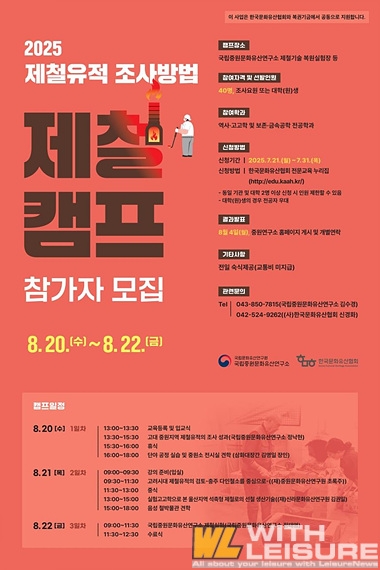
The National Jungwon Research Institute of Cultural Heritage (Director Jo Sang-sun; hereinafter the "Jungwon Institute"), under the National Research Institute of Cultural Heritage of the Korea Heritage Service, announced that it will hold an ironmaking camp together with the Korea Cultural Heritage Association (President Kim Chang-eok) for three days from August 20 to 22 around the Jungwon Institute's ironmaking restoration experiment site in Chungju, North Chungcheong Province, and that it is recruiting camp participants until the 31st.
The ironmaking camp is a program designed to publicize the results of various ironmaking-related excavations and ironmaking experiments centered on the Chungju area and to train ironmaking researchers. The Jungwon Institute and the Korea Cultural Heritage Association jointly prepare it every year to energize ironmaking research.
This year, the camp will run for three days and two nights, with four theory lectures and two hands-on sessions. On the first day, participants will review the research findings on ironmaking sites in the ancient Jungwon region (Jeong Nak-hyeon of the Jungwon Institute), focusing on the excavation of the Chilgeum-dong site in Chungju, and can take part directly in a forging (danya) process practicum led by master craftsman Kim Myeong-il, holder of the Chungju intangible cultural heritage Samhwa Blacksmith Shop.
On the second day, participants will examine the characteristics of Goryeo-period ironmaking sites (Jo Rok-ju of the Jungwon Institute of Cultural Heritage) and receive a lecture on pig iron production technology in stone-built ironmaking furnaces in the Ulsan area as seen through experimental archaeology (Kim Gwon-il of the Silla Institute of Cultural Heritage), looking at the pig iron production that was popularized through the Ulsan Soeburi Festival. Afterward, they will visit Korea's first iron museum, located in Eumseong, North Chungcheong Province, to learn about iron production technology from ancient to modern times. On the third day, a session will be held to discuss the methods and results of reproduction experiments of ancient ironmaking technology (Jeong Tae-yeong of the Jungwon Institute).
Eligible participants are (excavation) researchers interested in ironmaking research and undergraduate and graduate students in archaeology, history, conservation science and metal-related departments. Tuition, lodging and meals are free (transportation costs are not covered). Interested members of the public can apply on the professional education website of the Korea Cultural Heritage Association. The 40 finally selected participants will be announced on the Jungwon Institute's website on August 4 and notified individually.
The National Jungwon Research Institute of Cultural Heritage said it expects this "Ironmaking Camp" to help university and graduate students studying ironmaking and buried-heritage researchers strengthen their ability to understand ironmaking technology and investigate ironmaking sites, and that it will continue to steadily provide opportunities to share ironmaking technology and research findings of the Jungwon historical and cultural region.