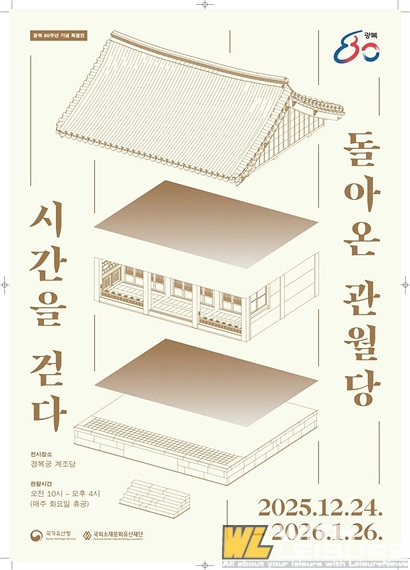
The Korea Heritage Service (Administrator Heo Min), together with the Overseas Korean Cultural Heritage Foundation (Secretary General Kwak Chang-yong), announced that to mark the 80th anniversary of Liberation it will hold the special exhibition 「Returned Gwanwoldang: Walking Through Time」 at Gyejodang Hall in Gyeongbokgung Palace (Jongno-gu, Seoul) through January 26, 2026. The exhibition sheds light on the journey of Gwanwoldang (観月堂), a Joseon-era building that was taken to Japan during the Japanese colonial period and returned to Korea after about 100 years.
Gwanwoldang is a wooden building constructed in the late Joseon period and is presumed to have been a shrine related to the royal family. Taken to Japan in the early 20th century, it passed through Tokyo and then stayed for about 100 years on the grounds of the temple Kotoku-in (高德院) in Kamakura, Kanagawa Prefecture. It returned to Korea last June through a donation by Kotoku-in's head priest, Sato Takao [佐藤孝雄].
The exhibition was organized to celebrate the return of Gwanwoldang, the first case in which Korean architectural heritage taken overseas has been recovered in its complete form, and to share with the public the historical significance contained in that process.
The exhibition lets visitors follow Gwanwoldang's journey through the building's components, which were dismantled for the return to Korea, along with records documenting the repatriation process. It shows that the return of cultural heritage is a public task that must be pursued together through the shared responsibilities and roles of many parties.
In particular, the exhibition allows a close look at representative dismantled components of Gwanwoldang. Visitors can learn about the role, function and symbolism of each part, including the jongnyang (main structural beam), the daegong (strut supporting the ridge purlin), the choyeop (a small component serving both as structural support and decoration for the gabled roof), and eave-end roof tiles (amaksae) carved with various designs such as dragon, spider, bat and demon-face motifs.
The exhibition is free for all visitors to Gyeongbokgung Palace and is closed every Tuesday, when the palace is closed.
The Korea Heritage Service and the Overseas Korean Cultural Heritage Foundation hope the exhibition, where visitors can see the journey of Gwanwoldang's return after about 100 years in one place, will serve as an opportunity to reflect on the value and meaning of repatriated cultural heritage. They will continue to offer a variety of opportunities for the public to enjoy the value of Korean cultural heritage returned from overseas.