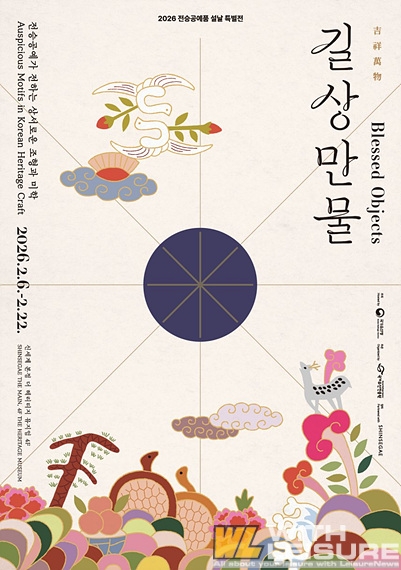
The Korea Heritage Service (Administrator Heo Min), together with the Korea Heritage Agency (President Lee Gwi-yeong) under its umbrella and Shinsegae Inc. (CEO Park Ju-hyeong), announced that it will hold the Lunar New Year special exhibition of traditional craftworks, 「Gilsang Manmul (吉祥萬物): Auspicious Forms and Aesthetics Conveyed by Traditional Crafts」, from February 6 to February 22 on the 4th floor of The Heritage Museum at the Shinsegae Department Store Main Branch (Jung-gu, Seoul).
The exhibition, themed on 'gilsang (吉祥, auspiciousness)' found in traditional crafts, takes on added meaning as it is held at 'Shinsegae Main Store The Heritage', which reopened after renovation of the former Korea First Bank headquarters, a Seoul Metropolitan Government tangible cultural heritage. Reflecting on today's life through traditional crafts in a place that was once the center of the economy can be called a symbolic attempt to connect history and the present, the material and the spiritual. The exhibition director is Kang Jae-yeong, CEO of Mangrove Artworks, who served as artistic director of the Cheongju Craft Biennale from 2023 to 2025.
The exhibition is organized around four themes: longevity and good fortune (subok gangnyeong), clothing, food, and shelter. Visitors can see about 250 works in some 130 types, including not only pieces embodying traditional techniques designated as National Intangible Heritage, but also works developed under the 'Traditional Craft Design Collaboration Support Project,' through which the Korea Heritage Service created opportunities for holders of National Intangible Heritage skills to collaborate with contemporary designers and supported the production of modern, popular traditional craftworks.
▲ 'Enjoying Longevity and Good Fortune' presents a staged display that expresses the feel of winter and a warm interior using shield kites, folding screens, bedding, moon jars and more, embodying the wish for longevity and good fortune. ▲ 'Clothing: Wearing Auspiciousness' lets visitors encounter crafts as vessels that draw in good energy in the place closest to daily life, such as flower shoes decorated with the ten symbols of longevity, traditional garments and ornaments. ▲ 'Food: Sharing Abundance and Plenty' symbolically highlights Korean food culture of praying for blessings through the auspicious motifs found on small dining tables, spoon-and-chopstick cases, and hwagak (ox-horn-inlaid) tea snack boxes. ▲ 'Shelter: Blessings Dwelling in Home and Space' presents traditional crafts such as wooden furniture, hwagak chairs, candlesticks and mother-of-pearl boxes, which carry the hearts of ancestors who prayed for their families' well-being.
In addition, works from the 'Traditional Craft Design Collaboration Re-matching' project, which reinterprets existing products developed through the Traditional Craft Design Collaboration Support Project, will also be displayed. Some of the exhibited works will also be available for purchase online via QR codes.
A variety of experience programs and events linked to the exhibition theme of 'gilsang' will also be offered. An activity in which visitors can stamp seals with various auspicious patterns that carry the meaning of longevity and good fortune is open to all visitors.
The lucky pouch (bokjumeoni) making experience will be run 21 times during the exhibition period, and participants can make advance reservations on a first-come, first-served basis (10 people per session) through the Korea Heritage Agency's Instagram accounts (@k.heritage.agency, @k.heritage.craft) starting January 30. A photo zone has also been set up where visitors can choose the auspicious pattern they wish for in front of a folding screen and a wish tree and take a picture, offering varied ways to experience the meaning of 'gilsang.' In addition, for five days from February 6 to 10, between 12 p.m. and 5 p.m., the first 30 visitors each day will receive a lucky pouch containing a traditional-game souvenir (gonggi stones or yut game).
The exhibition is free and open to any visitor who arrives within opening hours. Detailed information is available on the Korea Heritage Agency website (www.kh.or.kr). Opening hours are 10:30–20:00 from Monday to Thursday, and 10:30–20:30 on Fridays, Saturdays, Sundays and public holidays. The exhibition is closed on February 17 and 18.
The Korea Heritage Service and the Korea Heritage Agency hope that this exhibition will bring traditional craftworks closer to the public, and plan to continue providing steady support and proactive administration so that the value of intangible heritage passed down across generations can spread widely.