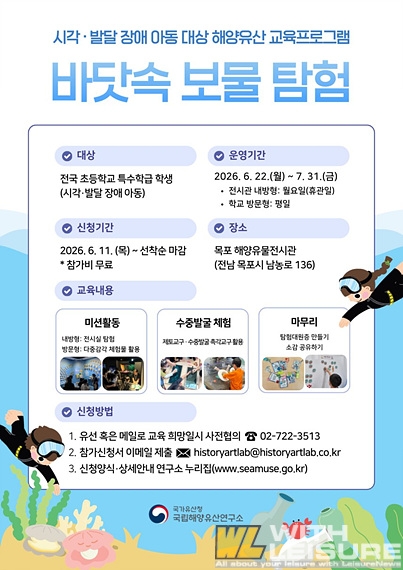
The National Research Institute of Maritime Cultural Heritage (Director Lee Eun-seok; hereinafter "the Institute") under the Korea Heritage Service announced that it will run "Underwater Treasure Hunt," a customized maritime heritage education program, from June 22 to July 31 for children with visual and developmental disabilities in special-education classes at elementary schools nationwide, including in Seoul and Gyeonggi.
The program actively reflects the characteristics and educational needs of children with disabilities, and is designed so that they can learn about the value and history of Korea's maritime heritage and the underwater excavation process through multisensory experiences involving sight, touch and smell.
The curriculum is divided into three courses according to the circumstances of participating schools. ▲ The integrated course (90 minutes) uses the closing day (Monday) of the Mokpo Maritime Relics Exhibition Hall to conduct exhibition-room missions and an underwater excavation experience in a calm and safe environment. ▲ The advanced course (120 minutes) is also run on the hall's closing day and is split into a first session (underwater excavation) and a second session (maritime heritage), offering in-depth visual and tactile learning. ▲ The visiting course (90 minutes) is for schools located too far to visit the hall, with instructors visiting special-education classrooms in person to deliver the lessons.
Participating students begin with audiovisual instruction and then learn using multisensory teaching tools prepared in the exhibition hall and classrooms. They become familiar with the shapes of maritime heritage by touching tactile replicas, such as a celadon hourglass drum with iron-painted peony design and a celadon duck-shaped incense burner, and also take part in an olfactory experience, smelling spices such as pepper, cinnamon and cloves that were once loaded on trading ships. They can also naturally come to understand maritime heritage using the "Sinan Ship Tactile Pad," which integrates voice, braille and sign-language explanations, and "multisensory braille teaching materials."
In the underwater excavation experience, students try on actual diving equipment and use magnetic tools to find cultural relics buried in soil. An "underwater excavation experience box" activity, in which they feel the excavation process through sound and vibration, is also offered.
In particular, to reduce the burden of long-distance travel for children with disabilities, the Institute plans to provide transport vehicles to classes that applied for the Institute's visiting education but have difficulty renting a vehicle.
An official at the National Research Institute of Maritime Cultural Heritage under the Korea Heritage Service said, "We will continue our proactive administration, steadily creating opportunities for everyone to understand Korea's maritime culture and maritime heritage without barriers."